

Harbinger

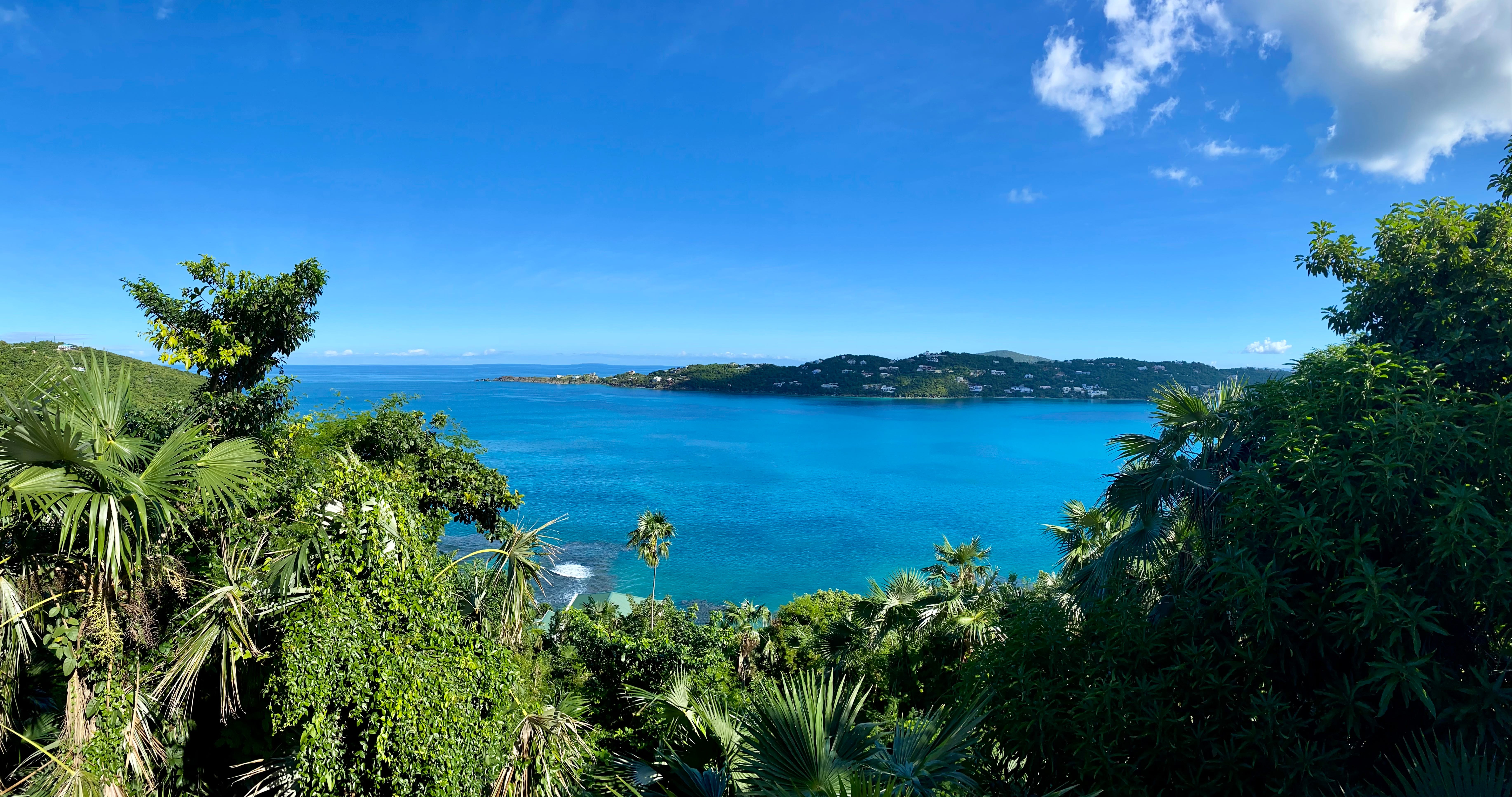
It was a very chilly first few days of 2025. Ian and I were looking forward to our honeymoon, and escaping to some sun and sand. Watching the weather forecast, I was actually afraid we wouldn’t be able to go at all—a serious winter storm was due, which in Virginia can make driving unsafe pretty quickly. Thankfully, the roads were passable when we set off at 5 AM, and we drove through snow at 16 degrees to the Richmond airport, where a water main break had left the entire airport without water. (Imagine: no bathrooms at an international airport, nor on the planes. It was wild!) It was a short trip to connect in Atlanta (hallelujah, running water), and then on to the tiny airport in St. Thomas. We stepped off the plane into what felt like another world—85 degrees, sunny, surrounded by lush mountains plunging into a vibrant azure sea. Even though St. Thomas is the most developed of the three US Virgin Islands, it’s still mostly forested land.
Part of what felt so amazing about being there was just being around SO many trees. The sheer number was somehow unbelievable. Our first Airbnb was nestled into the side of a mountain, surrounded by jungle, and overlooking the stunning Magen’s Bay. Wildlife abounded; the night sounds of the peepers were a symphony overlaid on the sounds of gentle waves. We were visited daily by lizards, wild chickens, and feral cats (one of whom made friends with Ian). We very quickly became embedded in this wilderness, and it was easy to remember that we’re not something separate from nature, but rather a part of a beautifully vast and complex ecosystem.
We’d planned to spend a lot of time in the water, snorkeling and scuba diving, and hoped to plug into efforts to study and help restore the coral reefs there. To that end, we connected with a local organization that does coral reef rehabilitation, studying and tracking the St. Thomas reefs, and growing new ‘baby’ corals in nurseries and then outplanting them back into the dying reefs. Turns out both Ian and I came close to going into marine biology earlier in life, so we had fun nerding out with the folks at CWORI (Coral World Ocean and Reef Initiative), who were very kind and welcoming, and showed us all around their operations. (They didn’t have any current volunteer efforts happening, but they’re planning to open a conservation-focused dive outfit very soon, which will help train and educate divers about reef preservation and restoration. So awesome!)
The lead scientist at CWORI shared with us some of the difficult realities of their work, especially as ocean temperatures continue to rise. Even just a few years ago, he said that their success rate of baby corals surviving in the wild after outplanting was around 80%. But in 2023 and 2024, there were unprecedented heat waves, and their success rates dropped to 10-20%.
I’d known that ocean temperatures have been rising, and coral reefs have been bleaching, for decades now. (Sidebar: corals are so cool. While they may look like plants, they’re actually a kind of marine animal related to sea anemones and jellyfish. As colonial organisms, many individuals live and grow connected to one another, and to a kind of algae called zooxanthellae, to form the larger symbiotic structures we might think of as a single coral.)
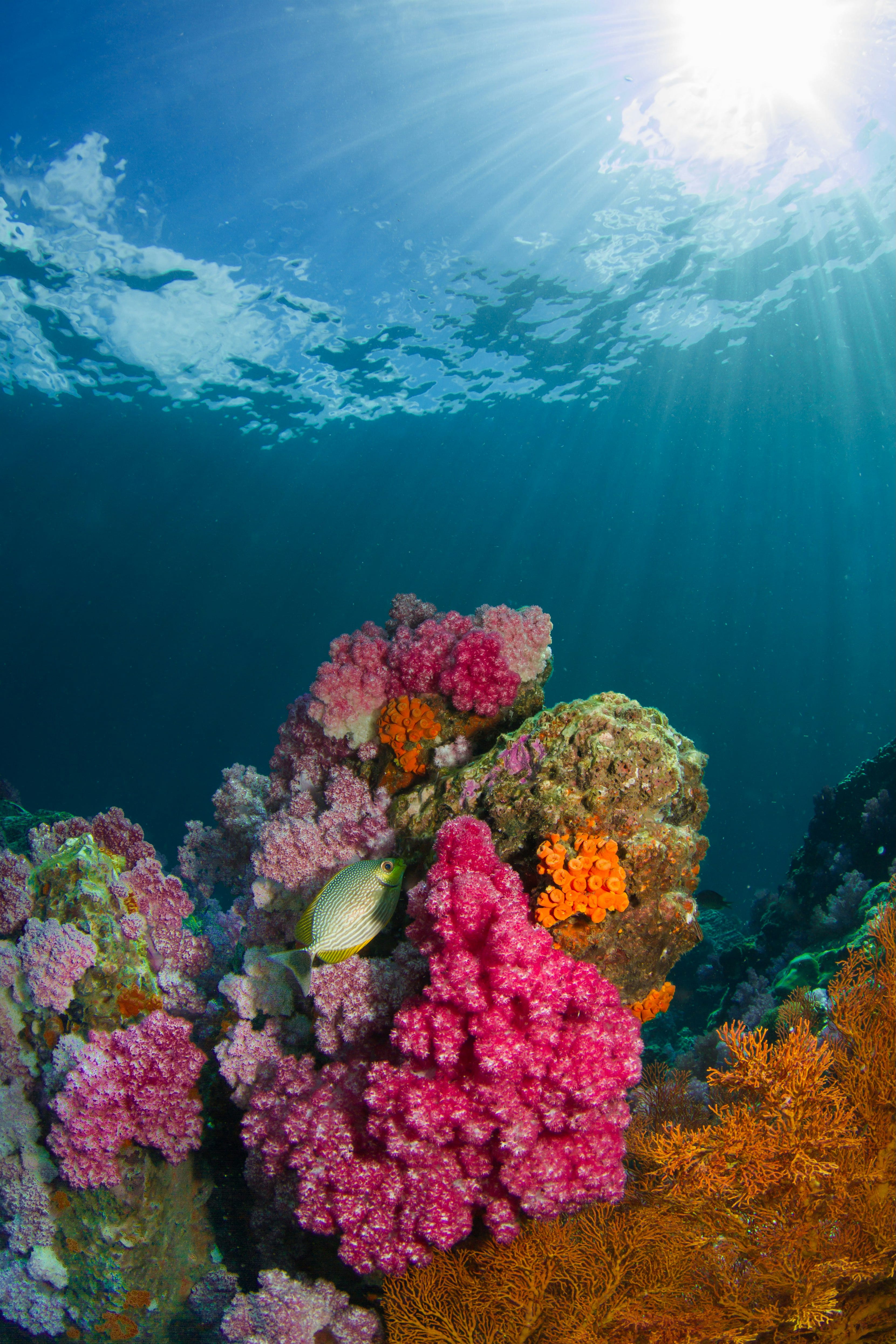
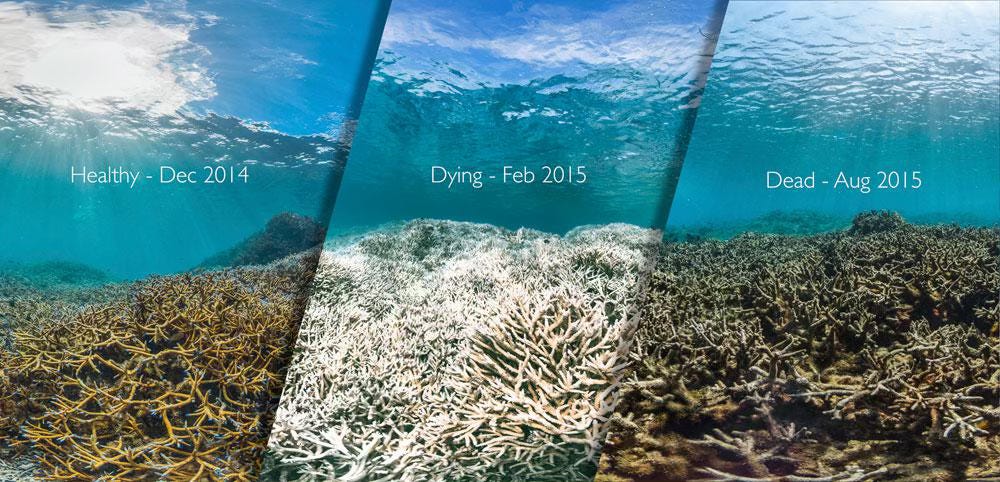
Bleaching is what happens when coral becomes stressed—usually from prolonged warm temperatures or increased concentrations of carbon dioxide in the water, causing ocean acidification. They then release the symbiotic algae, which is what gives coral its vibrant color (and also, it so happens, food and oxygen), and the white mineral exoskeleton that they’ve excreted is revealed. So, bleached coral is in very rough shape, and at high risk of dying.
I’m a fairly new diver, so I hadn’t yet been exposed first-hand to what this looks like on a large scale. The effect is truly ghostly. Here’s an example of bleaching from the award-winning documentary Chasing Coral:
We saw quite a bit of dead coral in the waters around St. Thomas, and it was surprisingly visceral for me at times. (As I shared in the last post, my scuba diving plans were thwarted by some ear issues, but I did continue to explore the ocean by snorkeling.) I remember one shallow cove close to our apartment, where we spent an hour in the late afternoon. The water was very warm, and it was located along the beach of a hotel resort, so there were many vacationers relaxing on the sand, enjoying the last few hours of sun before dinner. I imagined all the sunscreen that was dissolved daily into that small cove (most sunscreen contains chemicals that are very harmful to marine ecosystems). Coupled with the warm temperatures in that shallow bay, it’s not surprising that nearly all the coral there was dead.
As we swam along the surface, the small reef was just a foot or two below; sometimes the corals reached up to nearly brush against us, and we had to divert course to avoid them. It gave me the eerie feeling of floating through a graveyard, and the quiet of the underwater world, where the main sounds were my own breathing and the occasional clinking of stones with the gentle waves, added to the otherworldly (underworldly?) sense that was building in me. I also felt—quite clearly and strongly, in the embodied way that truth sometimes manifests—that I was looking at the future of what will be happening soon on land. (In many places of course, devastation from climate change is already in progress.) Like a visit from the Ghost of Christmas Future, it was a glimpse into what a landscape looks like when conditions have moved beyond what can sustain life. The desolation stretched as far as I could see. I was overcome with grief.
I realize this is a huge downer, but stay with me for a moment. I want to try to share something that’s been coming up for me more and more, that I haven’t figured out how best to talk about, let alone really process or deal with. So, here goes…
The Downside of Interconnection
Part of the worldview-shift that has motivated me into the space of herbalism and holistic health is the continually deepening understanding that I’m not separate from the rest of this world. Wait—already that sounds too cliché. I talk a lot about interconnectedness and the illusion of separation, and all of that is true. But that language also feels too removed, too cognitive, it smooths over the way this feels in my body.
What I mean is, I’ve come to see other beings on this planet—the trees along the roadside, my beloved cat, the millions of animals who are farmed so we can eat them, the mosquito biting my leg, the calendula plants in my back yard that I’ll harvest for medicine—as just like me. I don’t mean they’re the same as me, obviously. All of these beings are unique, just as all humans are unique. I mean ‘just like me’ in the way that: here they are on this planet, and they have some kind of will to survive, and some natural intelligence born of their ancestors. At the most basic level, they are a certain kind of manifestation of energy. They have as much right as I do to make their way in this world, to exercise their autonomy, to live and flourish as best they can. To the point, they are no less valuable than me. Or said another way, I’m not better than them. I’m not more important than them.
I’ve ‘thought’ these kinds of things for a long time. I’ve ‘agreed with these ideas.’ But now the knowledge has taken up residence in my body, which is a whole different ballgame.
This can show up for me in unsettling ways. For example, I was in northern Maine this summer, where my family has a rustic lakeside cabin, entirely off the grid. (One of my favorite places in the world! I’m sure I’ll write more about ‘camp’ another time.) After 5 days of unplugged goodness, we said goodbye to the woods and lake and cabin and started the long drive home. Maine is known fondly as the Pine Tree State—more than 85% of the state is forested, by far the highest percentage in the US—and there’s a large logging industry there. As we stopped for lunch, a truck rumbled by, stacked high with the trunks of pines, stripped of their branches and headed to the mill. And my first reaction was as if I were seeing a truck stacked with human bodies. I was taken aback, both at the horrific mental image, and also at how readily it popped up.
Somehow, my mind is slowly erasing the distinction—or the conventional hierarchy, in terms of value and rights—between humans and other species. So when I witness the ways that we control, destroy, and exploit other forms of life, the feeling that arises is like what I would feel if I saw that same thing happening to other humans, or to me. Later on during our Maine travels, I saw a heap of lobsters scrabbling at the bottom of a tank in a restaurant, their claws bound, nowhere to go, (unknowingly) waiting to die. I imagined how that would feel in my body, being cooped up like that and unable to move freely, and I just wanted to cry. Neuroscience/philosophy side note: Just because they have a simpler nervous system than us, or they can’t scream when they’re dropped into boiling water, doesn’t mean they don’t feel pain. It also doesn’t mean we have the right to treat them—or indeed, any being—with such indifference.
This is heavy stuff. These kinds of reactions in me are happening more and more frequently; meanwhile there’s a sense that a fog is clearing or a veil is being lifted, and I’m seeing things more clearly. Maybe my response is dysfunctional, or ‘overly sensitive.’ It’s certainly painful. But my sense is this is a natural part of breaking down the mental barriers between ‘self’ and ‘other’—a process I’ve spent years championing through the world of meditation and contemplative science. I believe that widening our circles of compassion, and our sense of self, is critical for the future of the planet. And it’s how I want to live. Damn, though—when it actually starts to happen, there’s a lot of pain there. Turns out, realizing interconnection isn’t all kittens and rainbows. I can see why I’ve spent most of my life walling myself off from such an intense form of empathy.
But I don’t want to live behind those walls anymore, because while they’ve shielded me from experiencing this particular kind of pain, they’ve also kept me removed, disconnected, from the incredible flow of the world. In fact, it doesn’t even really feel like this is something I’ve chosen… it’s just that the walls are crumbling.
I should note, I’m not arguing here that we shouldn’t eat animals, or we shouldn’t chop down a tree. We (unfortunately) need to take life in order to live, whether that’s plant or animal life. So for me, as I’ve started to see all forms of life as having equal value and right to their autonomy, it’s not so much about whether we’re eating plants or animals, or felling a tree for timber to build shelter, it’s a matter of how we relate to these other forms of life. Do we honor them in their inherent worth, feel gratitude that they’re sustaining us, put care into how we take their lives to cause the least possible harm? (Many Indigenous cultures who still live close to the land have retained this ‘kinship’ worldview.) Or do we blindly and callously use them for our own benefit, viewing them as ‘resources,’ without a thought to their experience in the world? For me, if I’m honest, more often than I’d like it’s the latter. But I hope that’s changing too.
So yeah, this is a complicated unfolding… I vacillate between resonating with (or sometimes being walloped by) a massive amount of suffering, and also feeling connected to and empowered by an incredible web of beauty and strength. And I’m keenly aware that the ethical and practical implications of this developing worldview are profound, upending much of what seems ‘normal’ in today’s society. I know I will keep learning how to integrate this new understanding, and eventually channel it towards good in the world. It’s a process. And I take comfort that many, many others before me have done this, are doing this.
Getting Unstuck
So I think all of this is partly why I was so struck, snorkeling in that shallow cove in St. Thomas among the dead coral, by what’s been lost, and by what felt to me like a harbinger of what’s to come. I suppose this is what’s meant by the term ‘eco-grief.’ The strange sadness stuck with me for weeks. Clearly, I can still tap into it now, many months later… I feel a kind of heaviness/pit in my stomach as I bring myself back to these scenes.
There’s something beautiful and powerful in grief, though. Grief comes out of love; it is a testament to something loved and lost. The key, I think, is to not get mired down in the grief, but also not to run away from it. To still feel it. Because if you can’t feel it, it can’t change you. It’s like allowing this powerful expression of love makes way for something new.
Thankfully, ‘leaning into tough feelings’ is a process I’ve learned many times through meditation and therapy over the years. It’s natural to want to run away from pain, to build internal walls. But avoiding difficult feelings doesn’t resolve or heal them—it usually makes things worse, creating a kind of emotional stagnation or stuckness. (I’m seeing more how this can show up physically too, in the form of pain or illness, as many healing traditions assert.) On the flip side, there’s actually a palpable relief in facing things as they truly are, despite it being painful. It’s like acknowledging the full catastrophe (to borrow a phrase from Jon Kabat-Zinn). Yes, these are challenging times. We as humans are creating a lot of suffering on this planet, for ourselves and other beings. That’s real. Admitting it allows the energy to flow.
It’s also real that we can be different. We can actually change—and maybe something about allowing that energy to flow is part of that. It is possible to view the world in a whole other way. And in order for us to change our systems, our norms, the culture we’ve built—the whole way we’re collectively doing this thing called life—it’s increasingly clear to me that we have to first change our mindsets. Without that change, we can build all the new technologies we want, or develop ‘greener’ ways of living, and it will end up being in service to the same old worldview of dominance and extraction and accumulation and separation. Without the mindset shift, we’ll just be forging different paths to the same end.
Which of course begs a question I’ve been circling for years: how do you change a mindset? This might be my favorite question of all, and so of course I don’t have a simple answer. It happens in a million ways—the accumulation of countless tiny experiences (consuming media, chatting with friends, reading a book, traveling, petting a cat or hanging out with a plant) coupled with a few good sledgehammer blows of insight. Enough to erode—or eventually break through—walls that have been entrenched for ages.
In the process of writing this, I’ve also realized that there are many medicinal plants that can help with these emotional dynamics, and with ‘getting unstuck.’ I love that my herb school emphasizes the way that a plant’s physical actions on the body will often have counterparts in the psychological realm. (Mind & body: two sides of the same coin!) I’m going to think more about this, and since this post is already quite long, I’ll devote a separate piece to that down the road.
If you’ve made it this far, thank you so much for reading and allowing me this space to share my experience.1 As I said, I haven’t figured out how to make sense of all this yet, but writing actually does help sort things out in my brain. I hope maybe there’s something here that’s helpful to you too. And next time, I’ll get back to the herbs! 🌿
Peripheral
If you feel moved to support coral reef restoration, check out the Coral Restoration Foundation, the largest coral-focused nonprofit, based in the Florida Keys. I’ve been following their work for years, and hope to dive with them someday!
The renowned Buddhist teacher, systems change thinker, and environmental activist Joanna Macy recently passed away at age 96. While her work has often been in my orbit, somehow I’ve never done a deep dive… but I’m starting to learn from her posthumously now, and all her work on eco-despair and The Great Turning is really resonating. I loved the first few episodes of this podcast she created with her student and friend Jessica Serrante just last year, in the final chapter of her life. Episode 1 on love and loss had me in tears.
I’m so grateful that I finally picked up and read The Serviceberry just as I was wrapping up this post. Oh my, what a gift this book is! Indigenous scientist Robin Wall Kimmerer speaks so beautifully—and with hope and inspiration—about everything I was fumbling through in this post, and much more, pointing us towards legitimate ways forward based on gratitude, reciprocity, community, and the lessons of the natural world. Genius, brilliant, heart-opening, must-read. (And a quick read too!)
I realize that there will be folks who read this and think, “Geez Wendy, toughen up! You’ve gone too far with all this interconnection stuff,” and others who have been living in this reality for decades, or their whole lives, and maybe wonder how it took me so long to get here. Wherever you fall along this spectrum is welcome, and I really appreciate you listening. 🙏🏼