

Respect your Elders

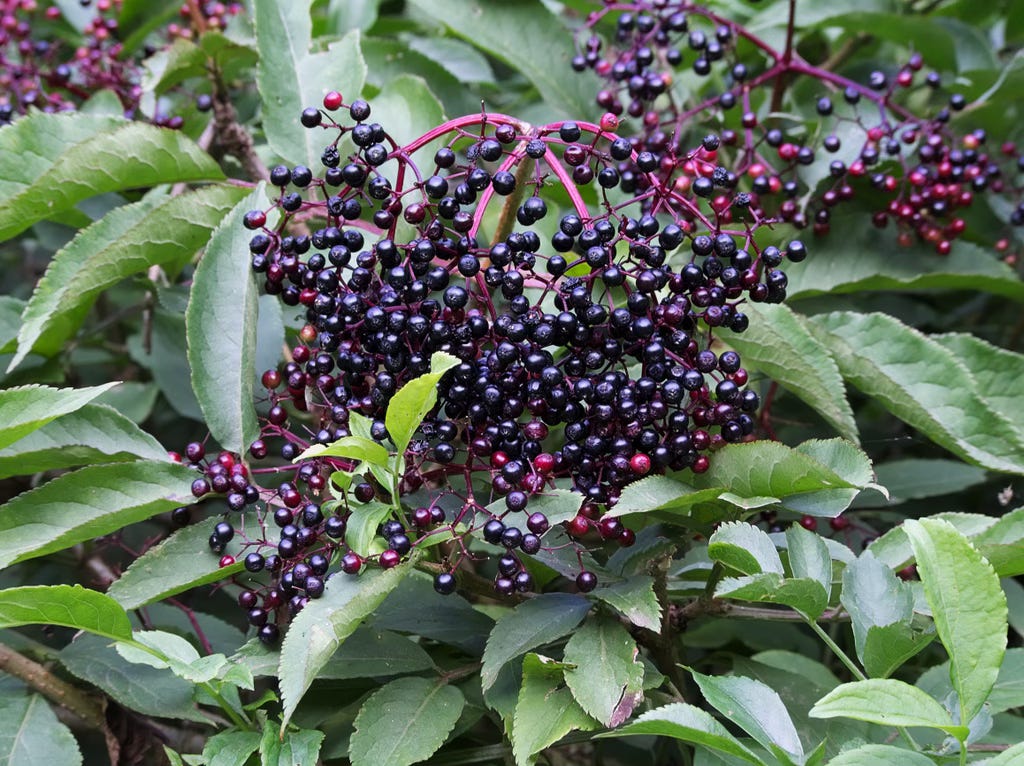
As it seems we’re in still the midst of a pretty nasty flu season, I thought I’d share one of my favorite remedies (and preventatives) for viral infections. Elderberry is one of the most popular herbal medicines in commerce today; you can find it in many forms, including syrup, tea, juice, wine, jam, tincture, gummies, and more. The flowers of the elder tree are also medicinal in different ways (and delicious as a liqueur like St. Germain), but I’ll focus on the berries here.
There’s good reason elderberry preparations fly off the shelves. In addition to thousands of years of medicinal use of the elder tree across cultures dating back to ancient Egypt, it’s also been the subject of some pretty serious scientific study (1600+ papers in PubMed). The health benefits of elderberry are wide-ranging, including improvement of cardiovascular, neurodegenerative, and inflammatory disorders, as well as anti-diabetic, anticancer, antiviral, antioxidant, and immuno-stimulatory effects. When COVID came on the scene in 2020, sales of elderberry products soared to $320 million, undoubtedly due to its reputation as an immune booster and antiviral agent.
It’s likely that a decent share of the positive impacts of elderberry come from its’ extremely high concentrations of a group of bioflavonoids called anthocyanins—which are powerful antioxidants. (See my last post for a bit more on why antioxidants, which reduce inflammation, are so important for our health today.) Fun sidebar: from a phytochemical perspective, the anthocyanins are what give berries their purple, blue, and red color. So it’s not just elderberries—think blueberries, raspberries, strawberries, blackberries, mulberries, huckleberries, etc. It’s a nice shorthand to be able to remember when selecting (edible) fruits and veggies: vibrant purple/red/blue = antioxidant power!
Aside from the overall antioxidant effects, how about its action against viruses in particular? Elderberry is one of the rare herbs that has been studied fairly rigorously in numerous human clinical trials. Results generally show that taking elderberry preparations for active cold and flu infection tends to 1) reduce symptoms, 2) shorten the duration of infection, and 3) reduce the use of other rescue medications (e.g., pain meds, nasal spray, cold tablets, antibiotics). Pretty sweet!
There are many possible mechanisms as to how elderberries have this effect, but a few have been studied in vitro (i.e., in a Petri dish), two of which I think are pretty cool. First though, a little bit on how viral infection works in our bodies. 🤓🦠
For a virus to cause an infection, it needs to enter our cells, inject its genetic material into them, and basically turn them into mini virus factories. This is how viruses replicate, and the new viruses produced then go and do the same to other cells, amplifying the effect and increasing the ‘viral load.’ Meanwhile, our immune system gets wind of the situation, and mounts a response to neutralize both the viruses and our infected cells. How quickly we’re able to clear the infection is a balance between the strength of our own immune response and how much viral replication is happening. So if you can slow down or inhibit viral replication, you can tip the scales in favor of our immune system to overcome the viruses that remain. This is what elderberry does!
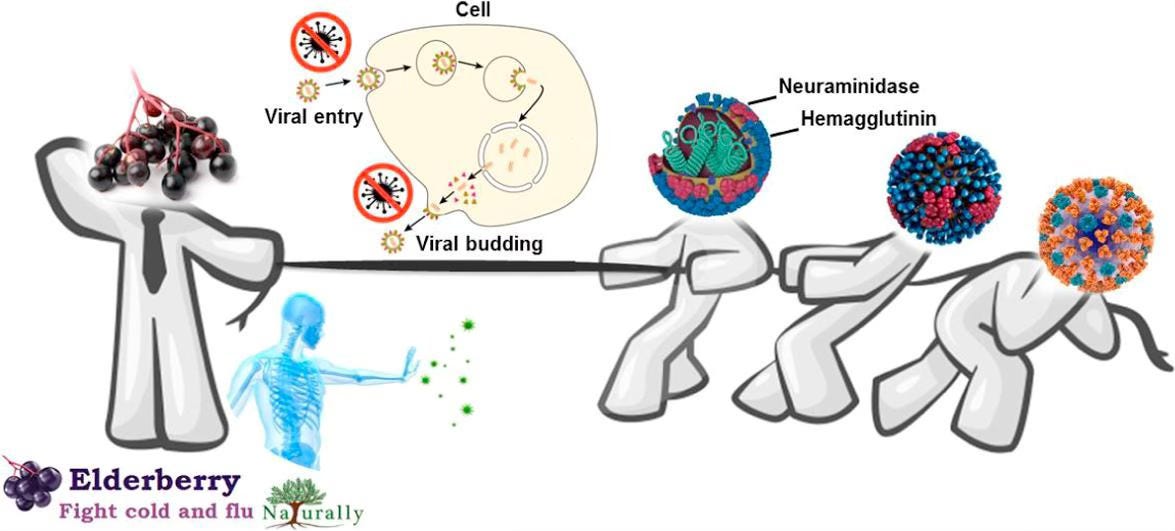
Research has found that constituents in elderberry interfere with the virus’s ability to attach to our cells, and also the process of our infected cells ‘spitting out’ the newly made replicated viruses (this is called viral budding). We actually understand a good bit about the molecular players involved, but I’ll just leave you with this ‘graphical abstract’ from the above paper, which I find pretty cheesy and weird, but also fairly informative. It’s basically depicting a tug of war between elderberry on the left (who is also, I guess, a business person?), inhibiting viral entry and viral budding, and influenza viruses on the right, with their spike proteins hemagglutinin and neuraminidase. These two proteins are critical for getting viruses into and out of our cells—key steps for replicating. Elderberry inhibits these two viral proteins, which is part of how it reduces viral load. Cool! Studies also suggest elderberry is effective against coronaviruses, including SARS-COV-2 (the virus that causes COVID).
It turns out elderberry can also increase the production of some cytokines that are part of our immune response, further adding to its beneficial effects against viral infection. No doubt there are many more actions in the mix, but these are the best understood, so I thought I’d share in case it’s useful—it always helps me, at least, to understand a little about how a plant I’m working with might be having its effects.
Because of the need for standardization in scientific studies, the research above is usually conducted using proprietary preparations (e.g., Sambucol), since the researchers can be fairly sure of consistent ingredients and dose. Not surprisingly, most of this research is also done with an eye towards developing pharmaceutical interventions, but from my perspective, since we know the actual plant material is super effective, um let’s just work with that! 😊 It’s fine to purchase commercial elderberry products, but you can also pretty easily make your own. I’ll share my basic recipe below (you can also find gobs of recipes online).
In terms of how to get elderberries for this recipe, there are a couple ways. If you know where some are growing (and you’re allowed to harvest), you can pick the berries when they’re ripe in summertime. It’s always lovely to work hands-on with the plants that will become your medicine. I generally cut whole clusters of berries and pick the individual berries off at home, as it can be a bit tedious (you want to minimize any stem content in your mix). You can then dry the berries in a dehydrator or a warm shed, or use them fresh and reduce the water in your recipe by about half. You can also simply order dried elderberries from a reputable source. (If you’re ordering from a big herb supplier like Mountain Rose Herbs, you can also get some elderflower, which is a nice addition to this recipe—add about 3/4 cup to the mix when simmering.)
Basic Elderberry Syrup
3 quarts water
~2 cups dried elderberries
1 cinnamon stick (or 1-2 Tbsp cinnamon chips)
8 cloves
3-4" fresh ginger root, sliced thin (not peeled)Combine the above and bring to a boil. Simmer for several hours until volume is reduced by half.
Strain and press the berries to get all the liquid out; compost the marc (that’s the leftover plant material) or give to chickens. Measure the total volume of liquid. The yield is usually around 5 cups.
Add 20% of this volume of honey (usually about 1 cup). You can short this a little bit, but I wouldn't go below 15%, as honey is included not only for taste; it’s an excellent preservative. When cooled touch, it’s also optional to add 20% of the yield volume of brandy (usually about 1 cup), which also helps as a preservative. If you’re not adding alcohol, stick to 20% honey.
This delicious syrup keeps in the fridge for several months. But you’ll likely use it up before then! A daily preventative dose is ~1 Tbsp 1-2 times/day. I love it over ice cream or in granola, smoothies, etc. If you’re sick or know you’ve been exposed, you can increase the dose considerably. Many of my teachers recommend taking it by the shot glassful (1 oz) every couple of hours. And you can always pair this with a thyme steam for extra antimicrobial action! 🌿
Peripheral
For years now, I’ve been wanting to find a functional, simple, cross-platform digital system to manage my recipes. At long last, I’m happy to share that Paprika Recipe Manager is a phenomenal app on all counts! I finally made the plunge and haven’t regretted it for a second. It’s just awesome—simple to use, easy to import new recipes (it even scoops them from bloated websites in seconds), and seamless across phone, tablet, and laptop. You have to purchase for each device, but it’s worth every penny. Game changer in the kitchen!
OK so I’m pretty late to this party, but I’m finally reading Four Thousand Weeks: Time Management for Mortals (thanks for the rec, Emily!) and WOW, what an engaging and eye-opening book. Oliver Burkeman shares some excellent perspectives on time, rest, what we think of as ‘productivity,’ and facing the reality that our days here are finite, and we’ll never be able to get it all done. (That sounds depressing but it’s actually quite a liberating book, trust me!) Humorous, philosophical, deeply practical, and potentially life-changing… definitely not what you’d expect from a book on time management. Loving it!
For all the puzzle-lovers out there, I recommend checking out Magic Puzzles if you haven’t yet. Hands down the most challenging—and simultaneously the most fun and engaging—puzzle I’ve ever done! There’s a bit of a story and a mystery and a ‘surprise’ involved in each one. Super creative; honestly it kinda blew my mind.
Congratulations, Wendy, on another engaging and super practical newsletter. I’ve shared with many friends who are likewise grateful.