

My gateway herb

My yard is full of ‘weeds.’ I’ve never cared much about having a pristine lawn, but I’d also never spent much time thinking about these humble plants until a few years ago. Dandelion, violet, plantain, clover, ground ivy… these have formed the blanket under my feet as I’ve puttered in the yard, often looking after their more ‘showy’ relatives (flowers, shrubs, trees, vegetables). In contrast to the plants I’ve cultivated and tended, these weedy species do quite well without any human intervention, thank you very much. They fly under the radar, flourishing and spreading, making the most out of poor soil, wildly variable water and sun, and constant trampling. They are paragons of resilience.
My journey with the plants started with a six-week introductory class offered by the herbalist Kat Maier, who incidentally also happens to be my neighbor. In the first session, she brought us out into her yard, which was filled with the same array of scrubby plants as mine. As she explained the medicinal power that these plants can offer, my mind was opened. I was intrigued at the possibility that plants could literally be medicine—not just some kind of weak version of a pharmaceutical, but actual medicine. I’d always thought of medicine as the pills you get from the drug store or pharmacy (Advil was counted regularly among the things I was most grateful for). Despite knowing that humans have worked with plants as medicine for thousands of years, I’d never really thought much about this wisdom tradition, and how that might be relevant to me today. I scribbled notes and hastily sketched the heart-shaped leaves of violet and the parallel veins of plantain, fascinated by the many effects Kat was describing.
Of course, learning information from someone else is different from knowing it in your body. One day shortly after that class in Kat’s yard, I was reading on my front porch. It was June, and the mosquitoes in Virginia were out in full force. As one inevitably feasted on my arm, I remembered Kat mentioning that plantain was a favorite for bug bites, and the quickest form of applying it was as a spit poultice.
As the spot began to itch and swell, I got up and scanned my front yard. Sure enough, there was plantain, along the edge of the walkway, in amongst the grass and other ground plants. It’s a ubiquitous plant in North America; surely you’ve seen it. (Note that this is different from the small banana kind of plantain that’s common in Caribbean food.)
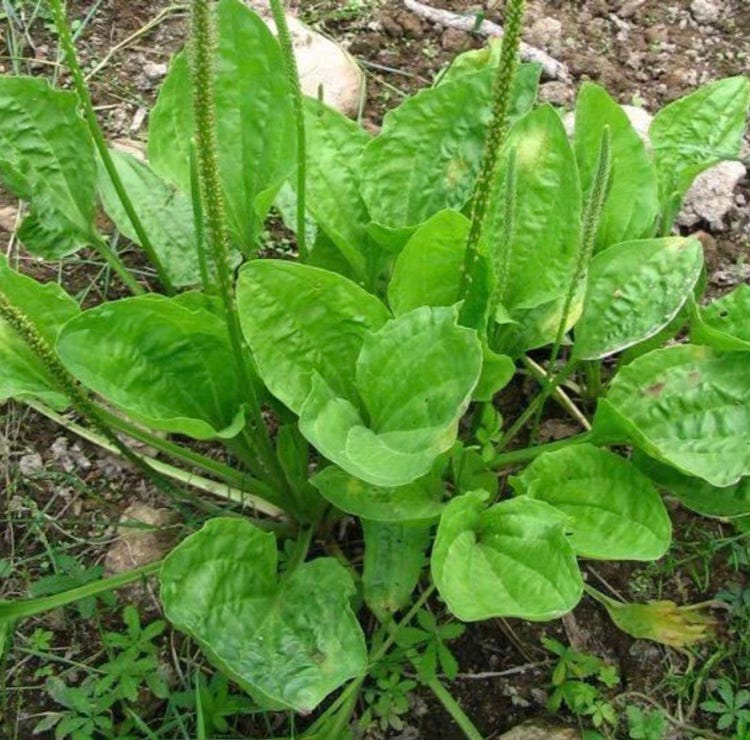
I picked a leaf and chewed it up, and pressed the resulting paste onto the bite. Within seconds, the itching stopped. It felt like magic. Even though I was alone, I’m pretty sure I looked at my arm and screwed up my face quizzically, one eyebrow raised, like Wait, really?!
I was hooked. I started telling everyone I knew about the wonders of plantain. (Apologies if this was you, and I was a little over the top. I was pretty excited.) As the weeks of class unfolded and I learned more, the world around me seemed to shift. All these plants, which I’d mostly overlooked my whole life, started to transform into potential allies. It made sense logically that plants have chemical constituents that can act in our bodies—after all, many of our modern medicines are derived from plants, and we’ve been evolving alongside them for millenia. With my background in science and my general bio-nerdiness, I initially thought that studying this kind of phytochemistry would be the main draw for me when it came to herbalism.
But there was something more foundational here. Slowly, I began to get the sense that, wherever I went I was surrounded by… somehow, friends. The plant world ceased to be just a backdrop to our seemingly-more-important human lives, things that are pretty to look at, or that can provide us with shade, or food. They are certainly all these things, but our relationship with plants runs much deeper, and is as ancient as our species. I couldn’t wait to get to know them in this new (old) way.
My understanding of plants has grown since that first encounter, of course. Looking back, relief from an itchy mosquito bite seems like a fairly simple, maybe superficial, action that a plant could have. And at the same time, the immediacy and potency of the effect was critical in shifting my mindset about what herbs could do.
Plantain has many talents. I’ll touch on just a few here. One is its drawing action—applied topically, it can pull out fluids or even foreign objects like a splinter. It’s also a great wound healer, helping mend tissue and soothe inflammation, which makes it doubly effective for bites, stings, skin irritations, scrapes, etc. Several months after my initial plantain experience, I was walking with a friend along some fields, and a bee stung my ankle. Again, a quick search turned up some plantain (once you start looking, it’s everywhere), and the poultice brought immediate pain relief as the angry swelling started to subside. Plantain is also perfect for when you have a splinter you can’t quite get to with tweezers; apply a plantain poultice, and within a few hours or overnight, the splinter will likely have emerged enough to grab it.
Maybe chewing up fresh plantain all the time feels a little cumbersome, or messy. (Funny memory: In the early days of my plantain-fanaticism, as my partner and I were leaving an outdoor party, I had stuck some spit poultice on his face for a mosquito bite. As we were driving away, he passed a colleague and started chatting, completely forgetting about the wet, green glob on his cheek. His colleague was kind, though I’m sure he was confused.) Thankfully, there are tidier ways to work with this plant. For these kinds of topical applications, plantain salve is super handy. It’s a staple for herbal first aid or a home apothecary.
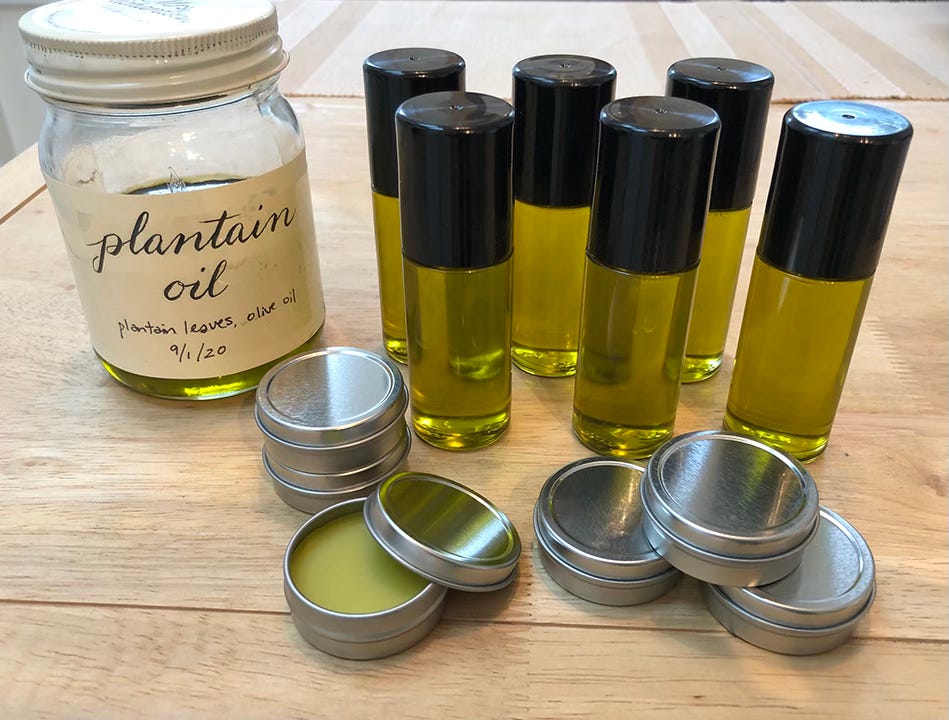
Generally, a salve is a mixture of oil that’s been infused with plant material (to extract various constituents) and beeswax; this preparation retains many of the medicinally active elements of the plant, and is easier to apply topically. Given how enamored I’d become, it’s not surprising that plantain was also the first infused oil and salve I ever made. Now instead of telling my friends to apply spit poultices all over their bodies, I could give them a little tin of my ‘bite balm’—which I was thrilled to learn they found super effective! Hearing that a medicine I’d made, as a total beginner with plants from my backyard, was helpful for people, was huge validation.
I was off and running.
Peripheral
A smattering of random recommendations & interesting tidbits:
If you’d like some plantain salve for yourself, there are gobs of people who sell this product on Etsy—a quick search will turn up limitless options. Check the reviews to make sure folks think it’s good quality. Here’s one I’ve tried and like. (And if you’re keen to try your hand at making some, just reply to this email and I can send you some resources.)
A poem I was recently reminded of, for those who may need it: Lost, by David Wagoner. I highly recommend listening to the lovely reading from Pádraig Ó Tuama.
I really enjoyed this piece by Tove Danovich about the Vaux’s swifts in Portland, Oregon—a poignant reflection on beauty, nature, loss, renewal, and the power of wonder.
Plantain was my gateway herb too. ✨💖✨